
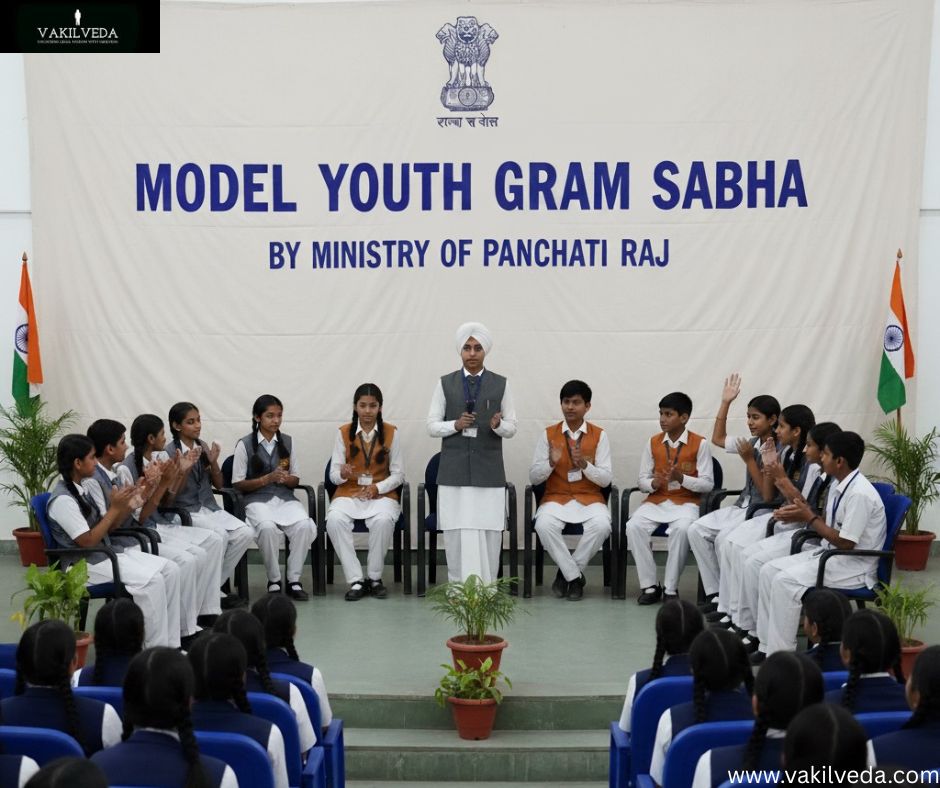
The Ministry of Panchayati Raj has conceived, an innovative civic education initiative, the “Model Youth Gram Sabha” (MYGS). The initiative is aimed at nurturing the democratic values and public responsibility among young citizens. It is being evolved and promoted in partnership with the Department of School Education and Literacy and the Ministry of Tribal Affairs. The concept of MYGS aims at encouraging and to the cultivate civic consciousness among the students. The MYGS Module is guided by the MLJP framework i.e. Meaning, Learning, Joy, and Pride, which anchors all activities in purposeful engagement, experiential education, and civic empowerment.
The MYGS has been based on the format of simulated assemblies. It provides students, particularly from the Jawahar Navodaya Vidyalayas (JNVs) and Eklavya Model Residential Schools (EMRSs), with the practical exposure to the functioning of grassroots democracy. Through the processes of role-play, debates, and decision-making exercises, students experience the processes of deliberation, consensus-building, and participatory governance. This experience based learning will not only enhance their understanding of local self-governance but also instils a sense of accountability, cooperation, and respect for the democratic institutions of our country.
The 73rd Constitutional Amendment Act, 1992 laid the foundation for a three-tier Panchayati Raj system. It empowered governance at the village, block, and district levels. By encouraging young minds to understand and engage with this framework, especially through recent initiatives like the MYGS, the Ministry envisions creating an informed and empowered generation that values democratic participation, constitutional ideals, and collective progress.
Objectives of MYGS-
- Educating the students about the Panchayati Raj System and local self governance.
- To encourage and motivate the students to engage themselves in the functioning and process of the Panchayati Raj System.
- To inculcate a sense of responsibility and leadership among the youth towards strengthening the Panchayati Raj Institutions.
- To provide a platform to students where they can discuss and analyze the real-life governance challenges at the grassroots level.
- To educate the students the real democratic value and importance of the Panchayati Raj System and institutions.
This initiative aligns closely with the National Education Policy (NEP) 2020 by nurturing constitutional values, social responsibility, and civic consciousness among students, preparing them for active citizenship. The program also fosters youth participation in the local self governance while developing essential life skills such as communication, critical thinking, teamwork, and consensus-building and decision-making for democratic engagement.
Model Gram Sabha/Gram Panchayat Meeting-
Nothing could be more effective mode of making the students to understand the Local Self Governance than a practical approach. In the Model Gram Sabha activity, students take on various roles to simulate real-world local governance. Some students may be designated as Sarpanch, Ward Members, or Presidents. Also, others may represent Standing Committees, Panchayat functionaries (like the Secretary, PDO, or Sahayak), frontline workers (such as ASHA, AWW, or Rojgar Sahayak), or officers from line departments, including Rural Development, Health, and WCD. Groups of students also represent different social segments of the Gram Panchayat to voice their community-specific concerns.
The meeting process includes preparation in advance, like circulating the agenda, issuing meeting notices at least ten days before the scheduled meeting, and disseminating meeting details widely. During the meeting, the Sarpanch leads with introductions, followed by presentations on past decisions, work-in-progress, new agendas, and finalization of the action plan. Additionally, they facilitate the discussions on financial management, including budget finalization, assessment of available funds, estimation of proposed works, and identification of funding gaps. They also explore potential sources for mobilizing additional financial resources. Students actively deliberate on addressing these gaps by proposing innovative ideas for local revenue generation.
Decision-making involves voting on key proposals, after which the Sarpanch summarizes the resolutions. The session concludes with the Minute Recorder drafting formal resolutions and the Sarpanch closing the meeting.
For each mock Gram Sabha Schools will be provided with Rs.20,000/- in the form of one time financial aid. The participating students will be provided with a certificates of appreciation from the Ministry of Panchayati Raj. Huge cash prizes will be offered to the 3 winning teams at the central level. The cash prize may be used for school development
Challanges-
- The initiative is very lucrative however it’s implementation will be challenging for school.
- The one time cash incentive Rs. 20,000/-, will be used in conducting the model Gram Sabha or for the Management or the staff?
- The teachers will be provided with training for conducting the Model Gram Sabha/Gram Panchayat but who will ensure that the Model Gram Sabha/Gram Panchayat is being conducted like real one because understanding their functioning/rules is a complex mechanism.
In order to ensure the effective implementation of the scheme of Model Youth Gram Sabha/Gram Panchayat, the school’s should seek assistance from the former officials of any Gram Sabha/Gram Panchayat. The former/present officials of the Gram Sabha/Gram Panchayat can also come forward to assist the schools in organizing Model Gram Sabha/Gram Panchayat.
Source: PIB