
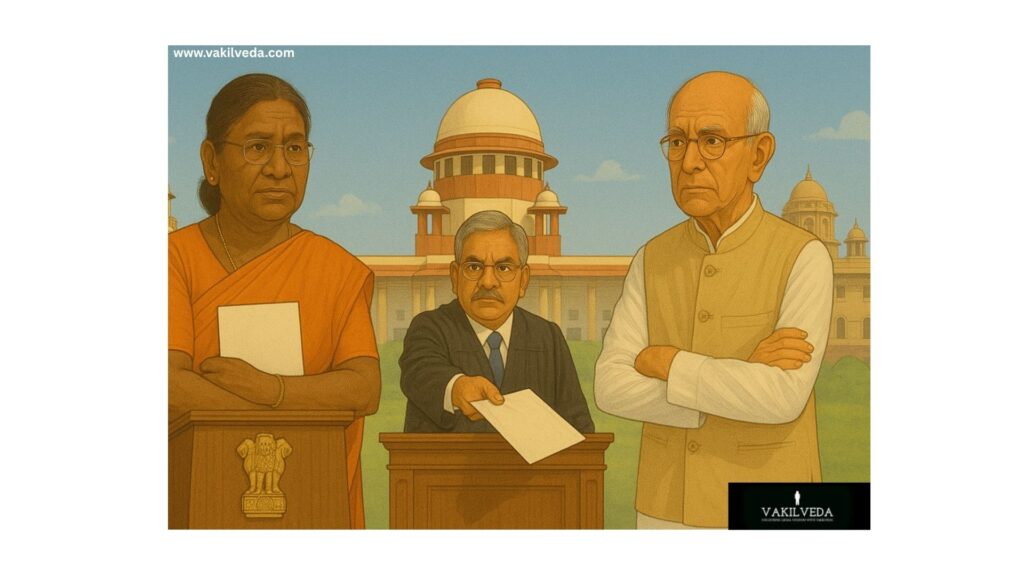
While considering this Presidential Reference under Article 143(1) of the Constitution of India relating to interpretation of powers of the Governor under Articles 200 and 201 of the Constitution for opinion of the Supreme Court; the Constitution Bench comprising Hon’ble Mr. Justice B.R. Gavai, Chief Justice of India, Hon’ble Mr. Justice Surya Kant, Hon’ble Mr. Justice Vikram Nath, Hon’ble Mr. Justice Pamidighantam Sri Narasimha and Hon’ble Mr. Justice Atul S. Chandurkar opined that:
- The Governor has three constitutional options before him, under Article 200, namely – to assent, reserve the Bill for the consideration of the President, or withhold assent and return the Bill to the Legislature with comments. The first proviso to Article 200 is bound to the substantive part of the provision, and restricts the existing options, rather than offering a fourth option. Pertinently, the third option – to withhold assent and return with comments – is only available to the Governor when it is not a Money Bill.
- The Governor enjoys discretion in choosing from these three constitutional options and is not bound by the aid and advice of the Council of Ministers, while exercising his function under Article 200.
- The discharge of the Governor’s function under Article 200, is not justiciable. The Court cannot enter into a merits review of the decision so taken. However, in glaring circumstances of inaction that is prolonged, unexplained, and indefinite – the Court can issue a limited mandamus for the Governor to discharge his function under Article 200 within a reasonable time period, without making any observations on the merits of the exercise of his discretion.
- Article 361 of the Constitution is an absolute bar on judicial review in relation to personally subjecting the Governor to judicial proceedings. However, it cannot be relied upon to negate the limited scope of judicial review that this Court is empowered to exercise in situations of prolonged inaction by the Governor under Article 200. It is clarified that while the Governor continues to enjoy personal immunity, the constitutional office of the Governor is subject to the jurisdiction of this court.
- In the absence of constitutionally prescribed time limits, and the manner of exercise of power by the Governor, it would not be appropriate for this Court to judicially prescribe timelines for the exercise of powers under Article 200.
- The President’s assent under Article 201 too, is not justiciable for similar reasoning as held with respect to the Governor.
- The President, too, cannot be bound by judicially prescribed timelines in the discharge of functions under Article 201 for the same reasons as indicated in the context of the Governor under Article 200.
- In our constitutional scheme, the President is not required to seek advice of this Court by way of reference under Article 143, every time a Governor reserves a Bill for the President’s assent. The subjective satisfaction of the President is sufficient. If there is a lack of clarity, or the President so requires advice of this Court on a Bill, it may be referred under Article 143, as it has been done on numerous previous occasions.
- The decisions of the Governor and President under Articles 200 and 201 respectively, are not justiciable at a stage anterior into the law coming into force. It is impermissible for the Courts to undertake judicial adjudication over the contents of a Bill, in any manner, before it becomes law. Pertinently, discharge of its role under Article 143, does not constitute ‘judicial adjudication’.
- The exercise of constitutional powers and the orders of the President/Governor cannot be substituted in any manner under Article 142, and we hereby clarify that the Constitution, specifically Article 142 even, does not allow for the concept of ‘deemed assent’ of Bills.
- There is no question of a law made by the State Legislature coming into force without assent of the Governor under Article 200. The Governor’s legislative role under Article 200 cannot be supplanted by another constitutional authority.
The Presidencial Reference came into existence for reason of the decision of Hon’ble Supreme Court in State of T.N. v. Governor of T.N.
[IN RE : ASSENT, WITHHOLDING OR RESERVATION OF BILLS BY THE GOVERNOR AND THE PRESIDENT OF INDIA; Special Reference No.- 1/2025, Dated- 20.11.2025]